The Third Australian LABYRINTH
installation and performance ritual by Metamorphic Ritual Theatre at the Easter EARTHCORE Festival completed the cycle of
every second Eostre (95, 97, 99). 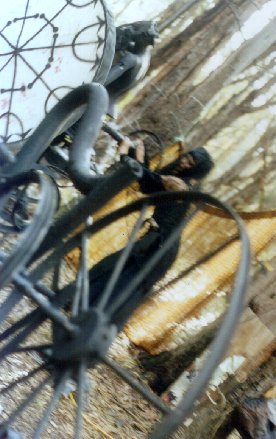 This production launched the LABYRINTH CD we'd been working on intermittently since the previous Labyrinth, translating the whole journey into intricate layered elemental soundscapes. The Lyrics from this CD have now been added to the 'Labyrinth ov Verse' accessible through the dryadic Labia Gateway at the end of this page. Audio samples from the CD are also included, and ordering information. 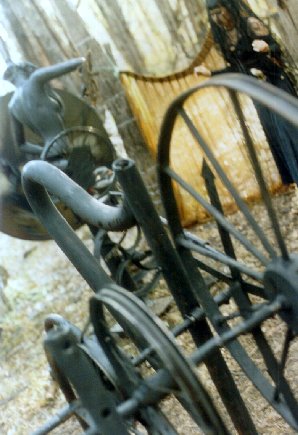 Our Labyrinths are interactive spaces in-which initiates meet different mytholological and mytho-illogical characters in different atmospheric environments as they wind their way through the maze, spiraling in to the centre where the night culminates in a final ritual performance before they are 'reborn' from this womb back into the rest of the festival. 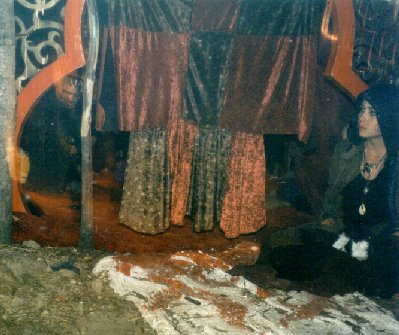 Right: Venom caught by the camera Right: Venom caught by the cameramutating in the Mutation Parlour at the Labyrinth Crossroads, while an unsuspecting patient waits outside
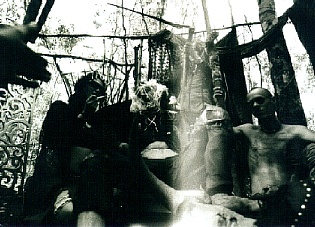
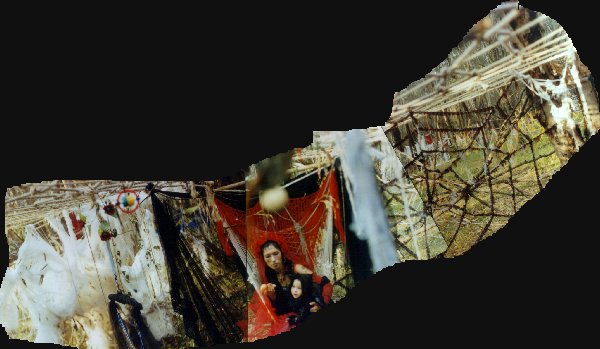 This time the Weaver/Mother's Weaving Chamber above) was seperate from the Dome where In-it-I-ates faced the Minotaur and the Cutter/Crone. 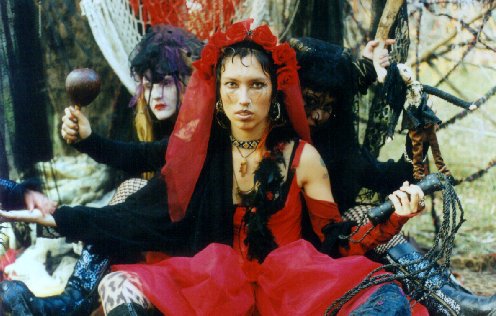 Thus there were three seperate spaces for each of the Three Fates, who at the end of each night would converge (photo at right) in the central arena when Thesea/s faced the Minotaur. 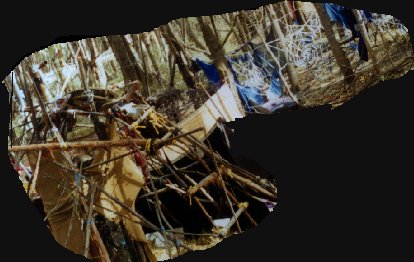 There was a large pit in the landscape which naturally formed this arena. Having no access to DTE's large metal geodosic dome this time, we built a small wooden one by bending saplings. This blended beautifully into the surrounding webbed woods. Amordios build a formidable gateway and antechamber (below) onto it where initiates about to face the Minotaur would await their fate one at a time.
The performance cycles
were different this year in that each night this time was to represent a different Aeon,
the different Minotaur and Thesea/Theseus character each night thus being
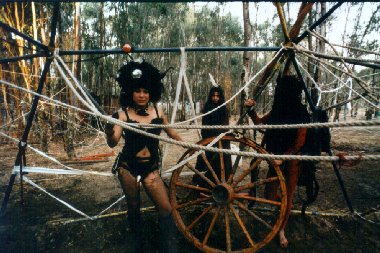
also the Egyptian deity representative of the successive Aeons. Thus this was the plan: 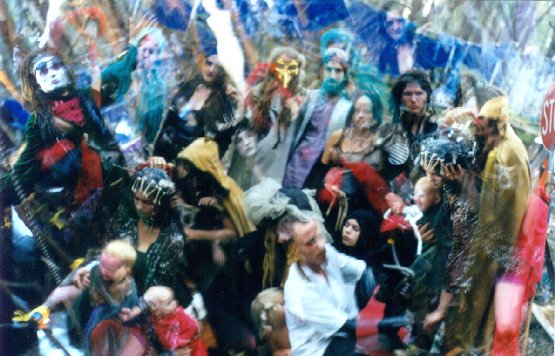 (Picture above: Group shot of The 3rd Labyrinth cast and crew. Two shots at the end of the film overlapped...) That was the plan; here's what happened!: I don't think I've ever encountered as many mundane obstacles as for this third Labyrinth. Everything that could go wrong, did. Buses and even replacement hire-vans breaking down, communication hassles, people coming down with major illnesses, etc. But in the end it was all worth it. Fantastic installation and aeonic rituals! We truly created another world. Perhaps the ordeals even heightened appreciation of the eventual results? It was all very razor's-edge -just enough time to set it all up after getting there days later than intended (lots of people working flat-out -amazing co-operation), just enough string to fill in the framework we wove, just enough funding to cover our (many unanticipated) costs, the Labyrinth CD copies arriving just in time, etc. 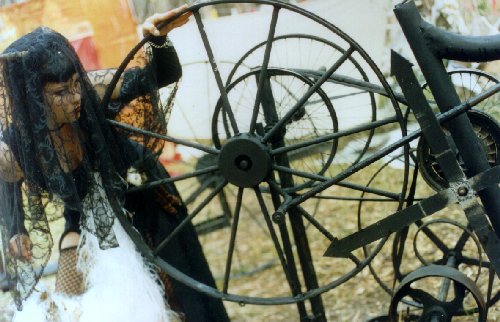 The first night was chaotic. The preparations were finished just in time to open. We were all exhausted but recharged incredibly on casting of the circle and opening of the rituals. Hundreds of people came through, it was a very fast and fiery energy. The little messages (words, questions, sigils and other triggers) the spinner (right) gave to initiates seemed to all go to the right people (even to the point of a silly one about slugs being received by someone whose nickname was Slug!), many of whom asked the Weaver about them later on their journeys. 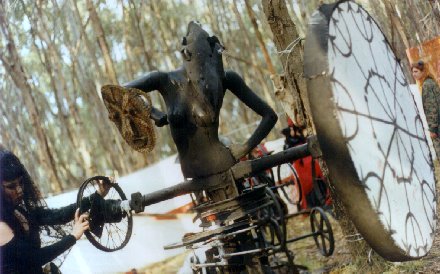 A strong induction of interest in Voudon in our clan (from several sources simultaneously) prompted inclusion of this aspect in our weaving. Our second intended performance night it poured with rain, so all we did was a short private ritual at the Elemental Crossroads, but this was very powerful: We combined the Voodoo tradition of burying and calling spirits into a head at the Crossroads, with a Marassa Baphomet rite by Louis Martinie, to charge up the Minotaur's head, decapitated on the first night's performance, with the energy of the Marassa/twins united into the hermaphrodite. We used the marassa-baphomet mudra and offered fruit, and blood from the piercings done in the Mutation Parlour (the gate of which was at the Elemental Crossroads) on the first night. 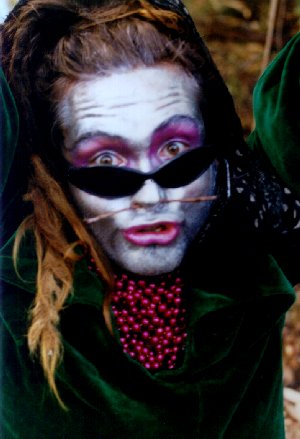 (Picture at right: Ken who played the Osirian Minotaur) The last night we condensed the intended performance for the previous night and the finale into one night. The Osirian Minotaur was killed by Theseus-Horus, the generator was turned off at his decapitation. As Anubis in jackal-mask I weighed his heart against the feather and granted him safe passage in Amenta. The generator was turned back on and the lights and music wound up again as the new Aeonic cycle began... But a mere 8 minutes or so after the crowning of Horus as the new Sun God, the Lord of Force and Fire exploded our generator! Bang bang bang!! Lights and sound wavering then out, extreme gunshot sounds (someone thought Ken was *whipping* the generator!) and great sparks. So Maat entered the central arena in silence! -most apt for the Goddess of Truth. Gradually acoustic music began to emerge as she and Horus danced their union, candles being lit and torches shone. 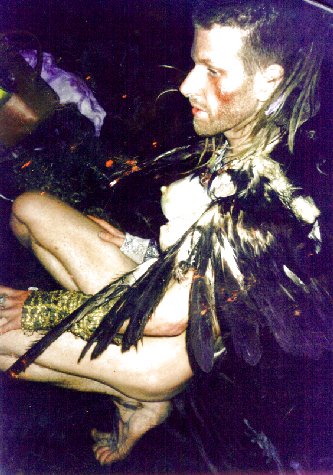 I appeared as the Baphometic hermaphrodite with goatskin and eaglewings. (My latex breast-job probably looked a lot more convincing in the candle and torchlight than it would've in the spotlight!) I took the silver cord from Maat as she and Horus sank united into the shadows, but Horus's golden cord had disappeared! He told me later that he had tied it securely around the hilt of his sword, but after slaying the Minotaur it had entirely vanished. No amount of searching in the subsequent week of unwinding at the site uncovered it! 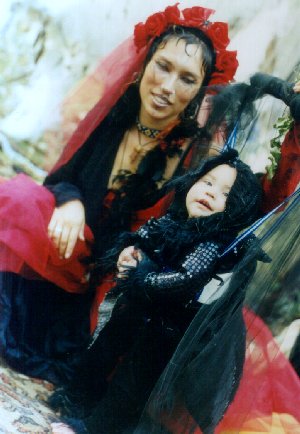 So the handfasting was not performed. Subsequent discussion of the aeonic meaning of this with the international HORUS MAAT LODGE decided that 'marriage' (even the pagan year-and-a-day marriage of handfasting) was an inappropriate metaphor for the union of Horus and Maat as incestuous twins (too formal, and She's already married to Thoth!) but it became evident that the union had occurred on some level -the Golden thread had crossed over onto the astral plane, where we traced it to the black light of Hunab Ku in a subsequent new moon working, while the silver cord (usually a metaphor for our etheric link to our astral bodies) had become physical. In terms of the original Theseus myth, the Golden Thread leads out of the Labyrinth. And indeed it has led me on to my next major project via that Working... (Photograph at left -Zya as the Weaver and her daughter Lilgimel as Arachne Jnr. -she hung bouncing from the webs in a decorated 'jolly jumper' spring device.)
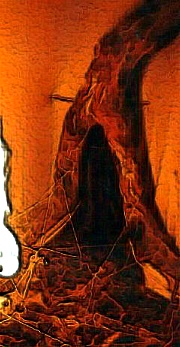
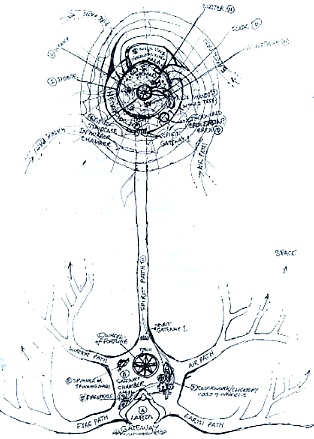
Following is an INTRODUCTION to the concepts of the LABYRINTH, with photographs, maps and accounts of our first two productions:The Labyrinth is an ancient pagan tradition existing in many cultures. It is basically a maze, usually spiralling, representing a womb. An initiate's journey in then out of the labyrinth was a symbolic death and rebirth experience for them. The Ancient Greeks made stone labyrinths, including the famous creation of Daedelus, in which was trapped the Minotaur, half-man, half-bull. The Druids, pagan priests and ecological protectors of England and Ireland's Celtic past, used to create labyrinths through the forests where they practiced their crafts, by winding ropes from tree to tree to form the paths. This is the method employed by Metamorphic Ritual Theatre to create the basic framework for their Labyrinth installations. The first, at DTE Confest Easter 95, was basically a traditional Labyrinth weaving, using no electricity or modern technology. Webs were woven with wool and string into the high and low ropes which formed the paths, becoming progressively denser and more textured towards the centre. The layout of this Labyrinth (designed by Orryelle, Bex and Ra'en) basically consisted of a spinning chamber which one would arrive in upon entrance, four spirals into the centre, and five elemental paths which connected these two main areas. Ancient myths from various different cultures (Greek, Norse, Celtic, Australian Aboriginal, Mayan) were woven together to form the essence of the performance/initiation cycles we presented upon opening the Labyrinth when the festival began. 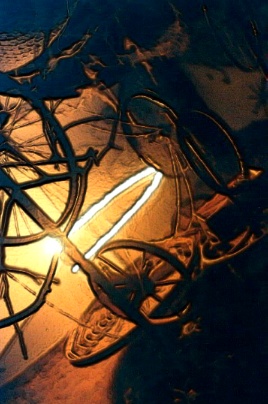 Initiates entered through the labia-like gateway, formed
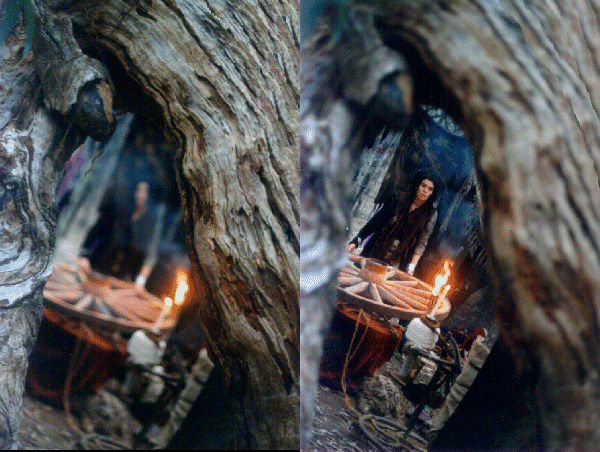
from an old forked tree inverted, and came into the Spinning chamber,
where they met Clotho -the maiden, the spinner, first of the
Three Fates, the Moerae. Sitting at her spinning-wheel, spinning
the threads of destiny, she requested they spin the Wheel of Fate. By
doing so, they selected one of four elemental paths through the Labyrinth,
as determined by where the torch on the wheel landed in relation to the
elemental pentacle beneath it. They then set off on their journey, bearing
the etheric threads given them by the Spinner. Initiates entered through the labia-like gateway, formed
from an old forked tree inverted, and came into the Spinning chamber,
where they met Clotho -the maiden, the spinner, first of the
Three Fates, the Moerae. Sitting at her spinning-wheel, spinning
the threads of destiny, she requested they spin the Wheel of Fate. By
doing so, they selected one of four elemental paths through the Labyrinth,
as determined by where the torch on the wheel landed in relation to the
elemental pentacle beneath it. They then set off on their journey, bearing
the etheric threads given them by the Spinner.
The elemental paths -fire, earth, air and water- were random
mazes through the woods, designed by those individuals or groups who
wove them. Sculpture, imagery and characters appropriate to each element
occupy these paths and confronted initiates on their journeys.
With their threads cut, initiates were sent (by Hermes -messenger, guide and psychopomp of the Labyrinth- down the spirit path (5th arm of the elemental pentacle) which led like a vaginal passage straight from the centre, back through the spinning chamber and out the labia gateway, to be reborn into the rest of the festival. Each night's cycle ended with the death of the Minotaur. An initiate would be chosen as Theseus, the hero. Upon entrance the spinner, who was also Ariadne, would give him a sword and the Golden Thread, which he was to unwind on his journey through the Labyrinth. When he reached the centre to face the Minotaur, the Three Fates would there converge forming an eight-limbed (six arms, two legs) triple-headed kama-kali spider formation. The battle eventually ended with Theseus lopping off the Minotaur's head (a costume appendage above the player's actual head), afterwhich he would then be crowned the new Horned God by Ariadne. On the following night's performance he would be the new Minotaur, and a new Theseus would be selected to come to slay him. This represented an ancient pagan tradition -the old Horned King dies, the new Horned King rises- a tradition we later decided to update rather severely in our second Labyrinth two years later.
It was a learning experience- we had never done such a project before, and the subsequent performances and installations developed from this tumultous beginning. The second night of the festival it poured with rain so we didn't open the Labyrinth. After some repair work, we reopened on the final night of the festival, and the energies had settled enough by this time for a focused performance cycle. In contrast with the first night, there was only a gradual trickle of initiates, and events flowed slowly and smoothly, with enough space for interplay between characters to fully develop. The wondrous circling, cyclical nature of the Labyrinth emerged as a powerful magic from ancient times. After several days of intensive de-construction/ cleaning up we vowed we'd never do it again, but two years later found ourselves discussing ways we could expand upon and enhance the original concept. We now knew how to create and run a Labyrinth, so why not develop it further? The second Labyrinth, held at D.T.E. Confest Easter '97, was an even more spectacular and intricate event. We received more funding from D.T.E., who remembered our earlier achievement, and we had a stronger core group committed to the realization of the project. We decided to use modern technology to develop the same basic mythological/ magical premises as used in our first Labyrinth. This was a cooperation between Metamorphic Ritual Theatre group and others, with Robin of international industrial sculpture group Mutoid Waste Co. contributing a huge spinning sculpture spitting jets of flame in a clearing on the fire path and helping out with technical and sculptural aspects, Clan Analogue setting up an analogue synth hands-on workshop space way out on the fringes of outer space (a tributary from the air path), DJ Krusty providing beats on the last night, and Sydney band Dweller on the Threshold co-crafting the soundscapes with Mutation Parlour and the Mozart Project.
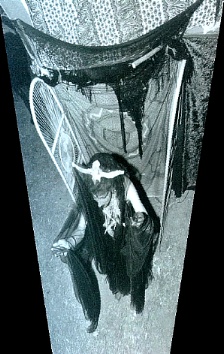 After facing the Minotaur, Death's gentle touch led them
into the mirror chamber (a smaller
version of this concept had occupied the water path of the first Labyrinth),
where they were surrounded by infinite reflections of themselves as they
ascended the spiral staircase which was the axis mundi of
the dome. This represented the journey to 'Caer Arianhrod', the
spiral castle of Celtic mythology where you go when you die. After facing the Minotaur, Death's gentle touch led them
into the mirror chamber (a smaller
version of this concept had occupied the water path of the first Labyrinth),
where they were surrounded by infinite reflections of themselves as they
ascended the spiral staircase which was the axis mundi of
the dome. This represented the journey to 'Caer Arianhrod', the
spiral castle of Celtic mythology where you go when you die.Emerging on top of the dome, initiates would then climb a rope ladder down to the Netherworld, a kind of 'cosmic waiting room' between incarnations. There they would remain until eventually Theseus arrived in the dome, provoking the final performance. Electric/electronic soundscapes created in the backstage area behind the dome begun as soft background noises when initiates were entering the Labyrinth, gradually increased in volume and intensity throughout the evening, until a full musical set accompanied the final battle. As with the first Labyrinth, various characters played acoustic instruments (drums, didgeridoo, violin, piano-accordian...) along the elemental paths, this time blending with the distant throb of the amplified central dome. This time Theseus was given an electro-sword, which sparked and crackled spectacularly when scraped along the metal of the dome structure. The generator was switched off when the Minotaur died, causing all lights and sound to de-generate into blackness and silence. From this rose an acoustic chant chorused by all the people involved in the Labyrinth's construction and enactment, the sound circulating as they formed a human web around the dome. Seven different chakra tones ascended the musical scale as the Minotaur ascended the seven steps of the spiral staircase, climaxed by a red flare shot off into the heavens with his spirit. Then Atropos cut the threads surrounding the Netherworld, releasing everyone down the spirit path to be reborn. The vagina for this second Labyrinth was a long fully-enclosing red stretchy fabric tunnel, so the effect when one eventually popped out the end of it, through the labia gateway, was quite divine!
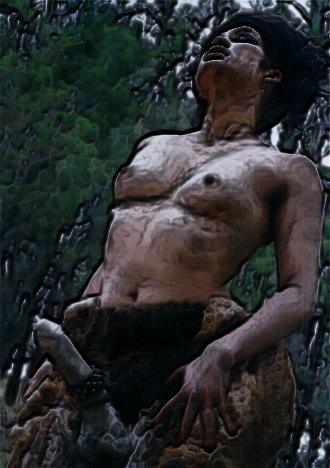
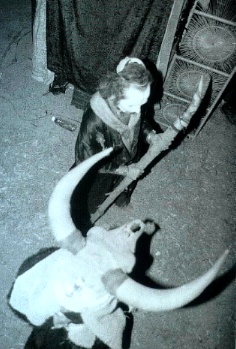
S/he paraded around the dome with bare breasts and large phallus (carved from a cow bone). This is the Age of the Hermaphrodite. Sun and Moon are united within in the alchemical marriage. I, too, became HermAphrodite from my role as Hermes, displaying my new symbolic bellybrand (see THE MUTATION EN- CYCLOPS-EDIA) and performing a Caduceus dance with snake-skins (stitched onto my arms in the parlour) and owl wings, invoking QuetzalCoatlicue
|
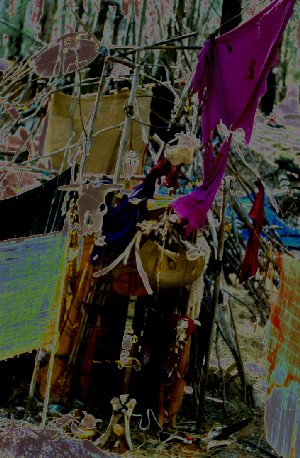
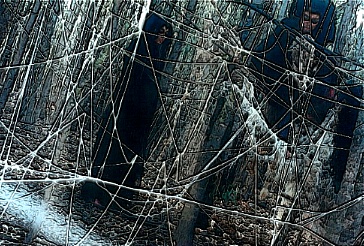 The opening of our first Labyrinth was a chaotic affair. We had
many more people than expected and it very rapidly got out of control.
Crazed trippers were running amuck everywhere, some desperately tearing
holes in the webs when they lost their way and the plot. Flaws in the
sructure quickly developed, eventually allowing initiates free passage
almost anywhere. The Spinning Chamber was soon flooded, and
thus not everyone experienced the full initiatory journey. However, fun
was had by all -the energy was intense, with all manner of strange characters
running everywhere. Despite the rampant chaos, the Weaver
managed to maintain a relatively focused energy in the inner spirals, the
calm at the center of the storm.
The opening of our first Labyrinth was a chaotic affair. We had
many more people than expected and it very rapidly got out of control.
Crazed trippers were running amuck everywhere, some desperately tearing
holes in the webs when they lost their way and the plot. Flaws in the
sructure quickly developed, eventually allowing initiates free passage
almost anywhere. The Spinning Chamber was soon flooded, and
thus not everyone experienced the full initiatory journey. However, fun
was had by all -the energy was intense, with all manner of strange characters
running everywhere. Despite the rampant chaos, the Weaver
managed to maintain a relatively focused energy in the inner spirals, the
calm at the center of the storm.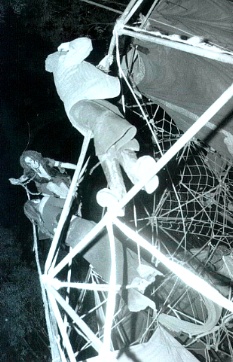
 The main constructional difference was the inclusion of DTE's large
geodesic dome in the centre. The web-like structure of its metal
framework fitted well within the spirals, and it provided an arena for
performance. Initiates were admitted into the dome one at a time by
gatekeepers on either side of it.
The main constructional difference was the inclusion of DTE's large
geodesic dome in the centre. The web-like structure of its metal
framework fitted well within the spirals, and it provided an arena for
performance. Initiates were admitted into the dome one at a time by
gatekeepers on either side of it.
 This second Labyrinth contained a