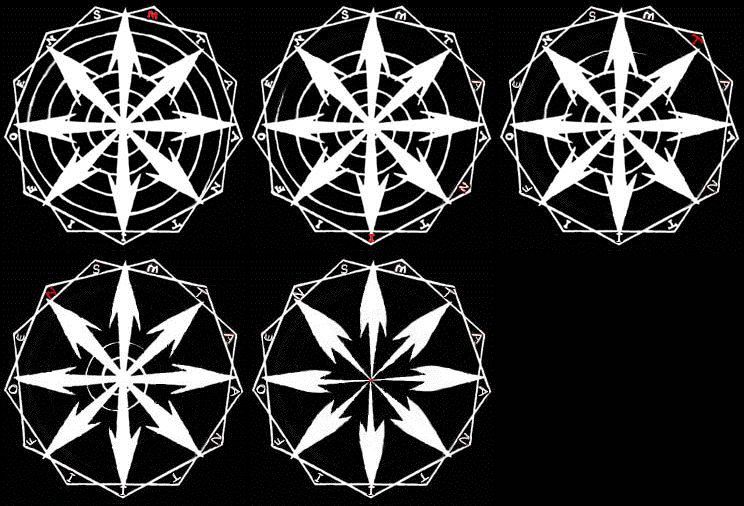
| Above is the anima-ted wo/mandala of The HermAphroditic ChAOrder of The SILVER DUSK
The 8 outward-pointing arrows of Chaos (expansion, exhalation) are counterpointed by the 8 inwards-pointing arrows of Order (contraction, inhalation) formed by the negative space
b e t w e e n them (which the spiral fills).
Together these represent the 16 kalas (emanations) or rays of Time whichcihw emiT from Kali, the Black Goddess of the Void (XAOS -the Greek root of the Word Chaos) The letters of the outer star spiral clockwise to Ma-nifestat-ion while the inner spiral inspirals counter-clockwise (clockfoolish).
The Great Serpent of Chaos, TiamaiT, was divided (ordered) into sections by Marduk, becoming T(he)-I-am-aT. Thus She is TeyaMayeT (Mayet is the Egyptian Goddess of The World Order, the earliest form of Maat), the sdrawkcab dnand forwards flow of TimemiT. The spiderweb formed by the rays and the spiral is a basic map for astral timetravel.
The Silver Dusk is a counter-point to The Golden Dawn -that where the Golden Dawn was a magickal order established by poets and artists, the Silver Dusk is an art movement instigated by magicians and sorcerers.
There has been a natural interweaving of the Occult and various revolutionary Art Movements (as thoroughly explored in 'Arcane Trajectories' by Fr.Kaotec, Oracle Magazine #2), for Art (especially modern and post-modern art) usually explores the subconscious realms of the psyche, and this is exactly what the esoteric (inner, as opposed to exoteric) or occult ('hidden') concerns itself with.
The interesting thing about most of these art movements however is that they flirted with esoteric and magickal ideas and concepts, but most of them failed to fully immerse themselves therein, partly to retain public credibility in an increasingly scientific-materialist paradigm, but also perhaps for fear of what might be found in the the dark recesses of the deep mind. In several cases the artists who began to go deeper into esotericism were expelled from the movements or groups to which they belonged, often apparently on the grounds that Art is something else other than 'magic'; While it was acceptable (even admirable) to use magickal models etc. as inspiration (indeed such symbolism was employed by Breton who expelled others from the Surrealist movement for becoming too deeply embroiled in occultism) there seemed often a prevailing attitude that one should not become too 'mired in mysticism'.
The SILVER DUSK differentiates itself from previous art movements (dada, surrealism, etc.) which dabbled in occultism in that our Art is totally immersed in and interwoven with Magic, no holds barred or separation for the sake of credulity in the vestiges of the Rationalist Age.
Scientific materialism is obviously not working anyway, as disaster looms when our technology advances without the spiritual wisdom to maintain it; so public opinion be damned, we will create irrational and esoteric 'art for art's sake', and for/as magic.
The Twilight imp-lied by our very name is its imagic language upon this cusp of conscious and subconscious spell-ing.
Despite the major involvement of several creative poets and artists in its ranks, The Hermetic Order of the Golden Dawn was primarily a structured and solar, scientific apprehension of magic, whereas The HermAphroditic ChAOrder of the Silver Dusk emphasizes an organic intuitive, lunar (arachnean) and poetic/artistic apprehension of magic. Art should not be contained, overly structured or clearly defined -it can however be channeled or directed. And that is the work/play of the Silver Dusk, to bridge that gap between order and chaos, conscious and subconscious, science and art, reason and intuition, Hermes (as mind) and Aphrodite (as emotion), et al. So collectively as artists, magicians and artist-magicians we are
The HermAphroditic ChAOrder of the Silver Dusk. This Order of ChAOS is purposefully 'hermaphroditic' and its name implies this play with dualities, including their convergence. We are about artistic and scientific apprehensions of magic, and their union; hermetic order-will and aphroditic chaos-love, and their convergence.
It is a twilight world, nebulous but deliberately so due to the potential therein (What do you see within the mist?) cf. the 'twilight language' of Adinath Tantra, laden with metaphor. Dawn is equally in-between, both dusk and dawn are neither day nor night thus ultimately bridging names as are 'HermAphroditic' and 'ChAOrder'.
Thus we apprehend Hrumachis (heiroglyphed as the Sphinx), Ancient Egyptian 'Lord of the Double Horizon' who deals with such s p a c e s i n b e t w e e n and is thus representative of this powerful period of aeonic transition.
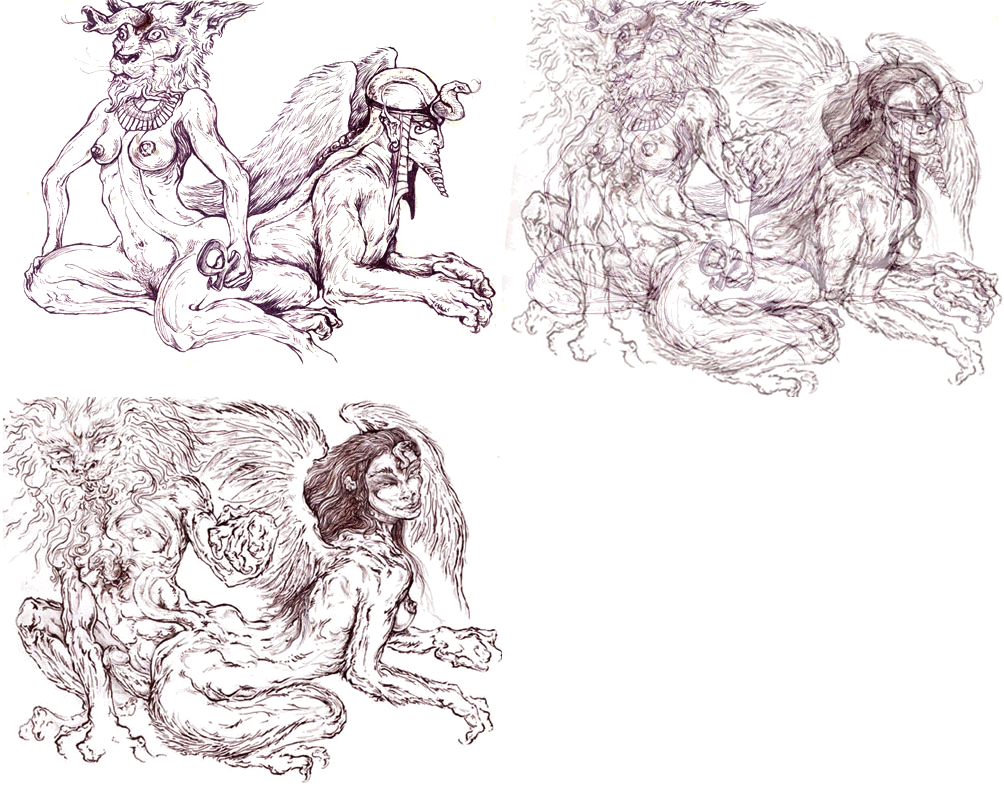
Double SphinX of Heru & Sekhmaat polarizes into Narasimha & the Greek Sphinga.
HruMachis Ainimation (c)'07 Orryelle Defenestrate-Bascule
Our name implies the different angles or perspectives and the convergence of dualities, although emphasis is given to the artistic-poetic side of it all, following in the ink-trails of A.O.Spare's and Andrew Chumbley's expositions on (and demonstrations of) the Artist as Magician.
The Silver Dusk is not however just a counterpoint but also a culmination of the 'day' begun by the Golden Dawn- acknowledging their wondrous inauguration of a modern magical revival, and completing this cosmic day, as well as heralding the onset of a cosmic night...
The Golden Dawn as a metaphor suggests the revival of the human spirit, but the Silver Dusk is not intended to imply its decline: we can see Dusk as the end of the day, or we can see it as the culmination and completion of the day; and we can see it also as the beginning of the night.
This suggests a love of the dark, ie the Unknown or Occult (meaning 'hidden'). That is only morally negative if we buy into the common yet inappropriate religious metaphor of light=good, dark=bad propagated by the mainstream monotheist religions. People are only afraid of the dark because they don't know what it might contain -the Dark is essentially just Mystery- it is passive and unlike light which can blind or burn, it is harmless; only what lies within it could harm us, particularly if we fear it- and as esoteric artists we must not be afraid to plunge headlong into the Abyss, as so many of the artists skirting around its peripheries and occasionally dipping in a toe were before us. The full range of artistic activity is our arena of expression, from ancient traditions such as painting, acoustic music and drawing to more modern mediums such as video, animation and other electronic expressions, and especially hybrids thereof.
Performance is an especially pertinent aspect of the Silver Dusk in that it is a public expression of ritual.
Metamorphic Ritual Theatre is a bridge between our internal and extant magical explorations, for we produce plays/works and interactive installations which aim to involve (to various extents in different works) and/or metamorphosize our audience as well as our selves, thus opening to them the gates of our own inner worlds and the mythic realms through the use of trance and archetypal symbolism.
The HermAphroditic ChAOrder of the Silver Dusk was and is and shall be ever a blend of tradition and innovation...
|